

Mob/Whatsapp:
+86-18098163178
E-mail:
sales19@rongroup.co


In commercial dining environments, restaurant furniture layout is far more than a visual decision. It directly determines how efficiently staff move, how smoothly guests are served, and how quickly tables can be reused. Restaurants that understand this relationship consistently outperform competitors operating in similar locations and price ranges.
When furniture placement supports workflow, restaurants gain speed without sacrificing comfort. When it does not, inefficiencies quietly erode revenue throughout every service.
Restaurant Furniture Placement Is an Operational Decision
Many operators focus on seating count while overlooking restaurant furniture placement as a driver of operational performance. In practice, layout defines the daily movement patterns of servers, guests, and support staff.
Poorly planned layouts force servers to:
Take longer routes between kitchen and tables
Navigate around chairs pulled into walkways
Slow down to avoid collisions during peak hours
Over time, these delays reduce server efficiency in restaurant operations and increase staff fatigue. Efficient placement, by contrast, allows movement to feel intuitive rather than reactive.
Restaurant Seating Layout and Service Flow
An effective restaurant seating layout creates predictable circulation. Servers should be able to move between service stations and tables without hesitation or interruption.
Key principles include:
Clear, uninterrupted primary aisles
Consistent spacing between table rows
Adequate chair pull-back clearance
When layouts ignore these principles, service flow becomes fragmented. Even small obstacles can slow service enough to affect restaurant table turnover during busy periods.
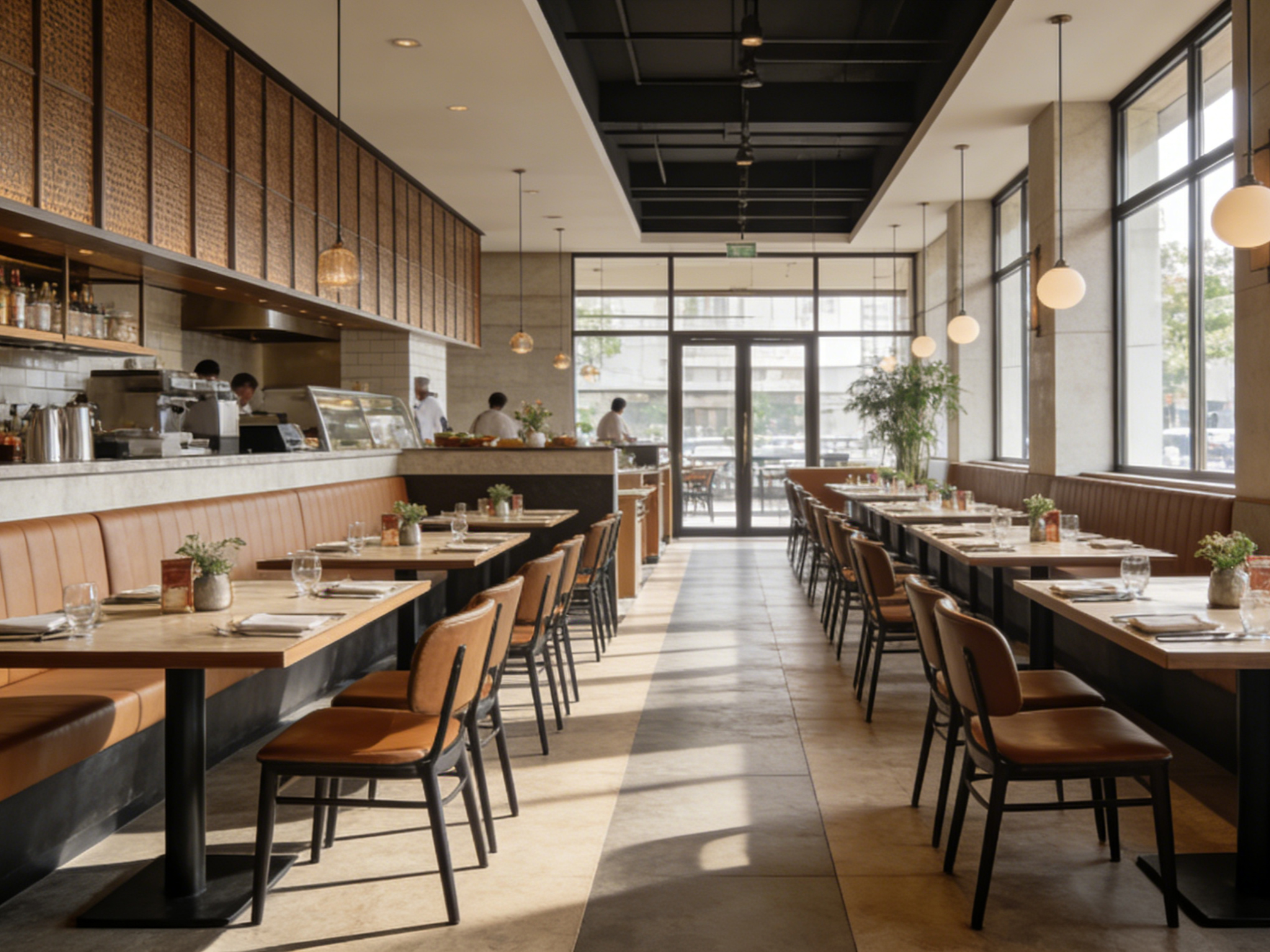
How Furniture Layout Affects Server Efficiency in Restaurants
Server productivity depends on repetition and rhythm. When the restaurant furniture layout is consistent, servers learn efficient paths and develop speed naturally.
Layouts that disrupt rhythm—through irregular spacing or shifting chairs—force staff to slow down. Over hundreds of table visits per shift, these interruptions significantly reduce restaurant workflow efficiency.
Restaurants designed around staff movement consistently achieve higher output with the same labor cost.
Booth Seating Layout vs. Loose Chairs in High-Turnover Restaurants
In high turnover restaurant seating environments, fixed seating provides control that loose chairs cannot.
A well-planned booth seating layout restaurant strategy offers:
Stable aisle widths
Predictable access points
Reduced need for constant chair repositioning
Loose chairs may offer flexibility, but they introduce variability that disrupts service flow. Fixed booth seating supports consistent movement patterns, especially in narrow or high-density dining rooms.
Table Spacing and Commercial Dining Layout Efficiency
More tables do not always mean more revenue. In many cases, overcrowded layouts slow down service and extend dining time.
An optimized commercial dining layout balances capacity with accessibility. Proper table spacing allows:
Faster approach and clearing
Easier guest entry and exit
Smoother coordination between staff
These factors directly influence restaurant layout efficiency and enable faster table resets without rushing guests.

Optimizing Restaurant Seating Layout for Turnover
To optimize restaurant seating layout, operators should consider zoning tables based on usage patterns. Fast-turn tables benefit from proximity to service stations, while larger or longer-stay seating works best along walls or secondary zones.
This approach minimizes cross-traffic and allows servers to serve multiple tables in a single loop, improving both speed and consistency.
Commercial Restaurant Furniture as a Performance Tool
High-quality commercial restaurant furniture supports these layout strategies through consistent dimensions, durable construction, and predictable performance. Furniture built for commercial use maintains spacing integrity over time, preventing gradual layout degradation caused by shifting or worn components.
When furniture and layout work together, efficiency becomes sustainable rather than temporary.
Final Perspective
Restaurants that succeed long-term do not rely on aesthetics alone. They treat restaurant furniture placement and layout as tools to improve movement, service speed, and profitability.
By aligning furniture decisions with workflow needs, operators can increase restaurant table turnover, enhance server efficiency restaurant-wide, and extract more value from the same footprint—without expanding space or increasing labor.


